

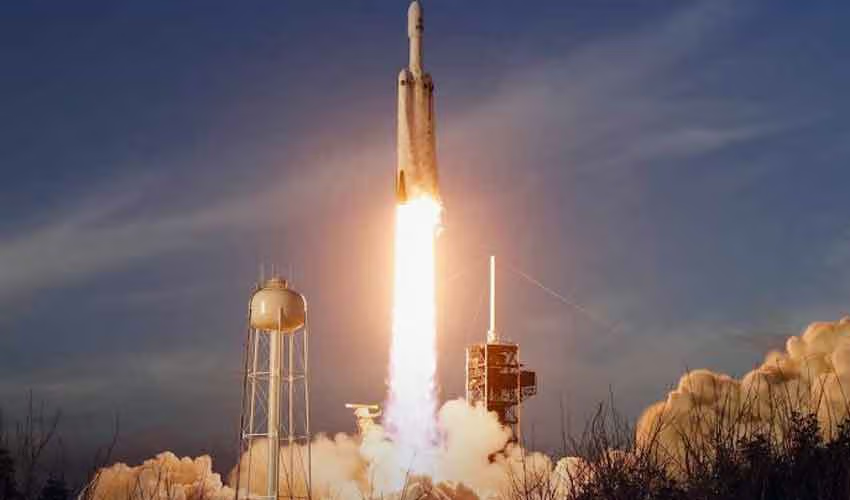
NASA has successfully launched its Nancy Grace Roman Space Telescope, sending the powerful new observatory on a journey into deep space to investigate some of the biggest mysteries in the universe.
The telescope lifted off at 7:26 a.m. EDT on August 30, 2026, aboard a SpaceX Falcon Heavy rocket from Launch Complex 39A at NASA’s Kennedy Space Center in Florida.



Roman is now beginning a roughly three-month journey toward its final operating location, about one million miles from Earth. From there, the telescope will conduct wide-ranging surveys of the universe and provide astronomers with an enormous amount of new data.
A New Era of Cosmic Exploration
The Roman Space Telescope has been designed to give scientists a much broader view of the cosmos than previous major space observatories.
NASA says Roman will have a field of view at least 100 times larger than that of the Hubble Space Telescope, allowing it to survey enormous areas of the sky while maintaining detailed infrared vision.
Rather than focusing only on individual objects, Roman will survey vast portions of the universe to help scientists understand how galaxies, stars and planetary systems have evolved.
Its observations are expected to contribute to major discoveries involving dark matter, dark energy, exoplanets and other astrophysical phenomena.
Studying Dark Matter and Dark Energy
One of Roman’s major scientific goals is to investigate dark matter and dark energy, two of the biggest unresolved questions in modern astronomy.
Dark matter cannot be observed directly, but scientists can study its effects on visible matter and light. Roman’s large-scale surveys will help researchers map the distribution of matter across the universe.
The telescope will also investigate dark energy, the mysterious phenomenon associated with the accelerated expansion of the universe.
By collecting observations across enormous regions of space, Roman could provide scientists with new clues about how the universe has evolved over billions of years.
Searching for Distant Planets
Roman will also play an important role in the study of exoplanets, which are planets located outside our solar system.
NASA says the telescope will conduct a statistical census of planetary systems in the Milky Way and will use its instruments to investigate planets and planet-forming disks.
One of Roman’s instruments, the Coronagraph Instrument, is designed to demonstrate technology for directly imaging planets around other stars by suppressing the overwhelming glare of their host stars.
The technology could help scientists develop more advanced methods for studying distant worlds in future missions.
Roman Will Complement Hubble and Webb
The Roman telescope is not intended to replace NASA’s existing space observatories.
Instead, it will complement telescopes such as Hubble and the James Webb Space Telescope by surveying much larger areas of the sky.
While other observatories can provide highly detailed observations of specific targets, Roman is designed to cover vast sections of the universe efficiently.
NASA expects the observatory to potentially measure light from billions of galaxies over the course of its mission.
A Million-Mile Journey
Following its launch, Roman will travel toward the Sun-Earth Lagrange Point 2, a region of space approximately one million miles from Earth.
Its location will allow the telescope to conduct observations from a stable position while maintaining a broad view of the cosmos.
NASA says the spacecraft is currently on its journey to its final orbit, with commissioning activities expected before the telescope begins its main scientific operations.
Why the Mission Matters
The Roman Space Telescope could transform the way astronomers study the universe by combining a wide field of view with advanced infrared observations.
Its enormous surveys could help scientists investigate how galaxies formed, how planetary systems developed and how the universe’s expansion has changed over time.
The mission could also uncover objects and phenomena that have remained difficult to detect using previous observatories.
With Roman now on its way into deep space, scientists are preparing for a new stream of observations that could provide important answers about the origins, structure and future of the universe.
NASA describes Roman as a flagship mission capable of exploring everything from planets in our own galaxy to distant galaxies near the edge of the observable universe.
WhatsApp Chat With Us Have a question? Send us a message. ›